The UK’s most-downgraded restaurant chains this quarter
Chain restaurants score better than independents on average. But the gap between the best and worst chains is enormous.
Here is something that is, at first, surprising: chain restaurants in the UK are, on average, cleaner than independent restaurants. We’ve written about this before, and the finding is robust — chains score better on hygiene inspections in every city, every cuisine type, and every region we’ve analysed.
But averages hide everything interesting. Within the category “UK chain restaurants” sits a spread wider than most diners realise. The best-rated chains in Britain carry near-perfect compliance records — fleets of 5-star venues, with almost no stragglers. The worst-rated chains have a third of their estate sitting at 3 stars or below, with persistent problems that have not been resolved across multiple inspection cycles.
This article ranks the 40 largest UK restaurant chains by aggregate hygiene rating, as of April 2026. We’ve pulled every individual venue’s inspection record from the UK Food Standards Agency’s open data, grouped by chain name, and calculated what share of each chain’s venues hold each rating tier.
The findings are uncomfortable for some chains and reassuring for others. They are also a live ranking — we intend to update this piece quarterly, so chains that improve or slide will move up and down the table over time.
How we built the ranking
Chain attribution is harder than it sounds. The UK government’s food hygiene database records every venue under its trading name, but there’s no field for “parent chain”. A Costa Coffee inside a petrol station might be registered under “Costa Coffee Ltd” on one inspection and “Shell Forecourt Services” on another. A McDonald’s franchisee might appear as “McDonald’s”, “McDonald’s Restaurants Ltd”, or the franchisee’s holding-company name.
To build the ranking we:
- Filtered to the 40 largest chain brands by UK venue count (brands with 100+ recognisable venues in the data)
- Used name-matching with manual review to attribute each venue to its parent brand
- Excluded venues inside supermarkets and forecourt stores, where the supermarket’s own food-safety management is the primary control, not the chain’s
- Calculated the share of each brand’s venues at each rating tier (5, 4, 3, 2, 1, 0)
- Ranked brands by the share of their venues at 5 stars
This is not a perfect methodology — no chain-attribution methodology is. But it is consistent, transparent, and reproducible. We plan to refine it in future quarterly updates.
The top performers
Several chains turn in near-perfect records. These are brands with 80% or higher of their venues at 5 stars, and essentially none below 3. They tend to share common characteristics:
- Strong central food-safety teams. The best-rated chains employ full-time compliance professionals who audit franchises on a fixed schedule, independent of government inspection cycles.
- Digital compliance tooling. Temperature logging, cleaning schedules, and supplier records are managed through chain-wide software, producing the documentation trail inspectors want to see.
- Small number of outlier stores. Even the best-rated chains have a handful of venues with lower ratings — usually recently-acquired sites not yet integrated, or specific franchisee problems. What defines the top performers is the speed at which they resolve outliers.
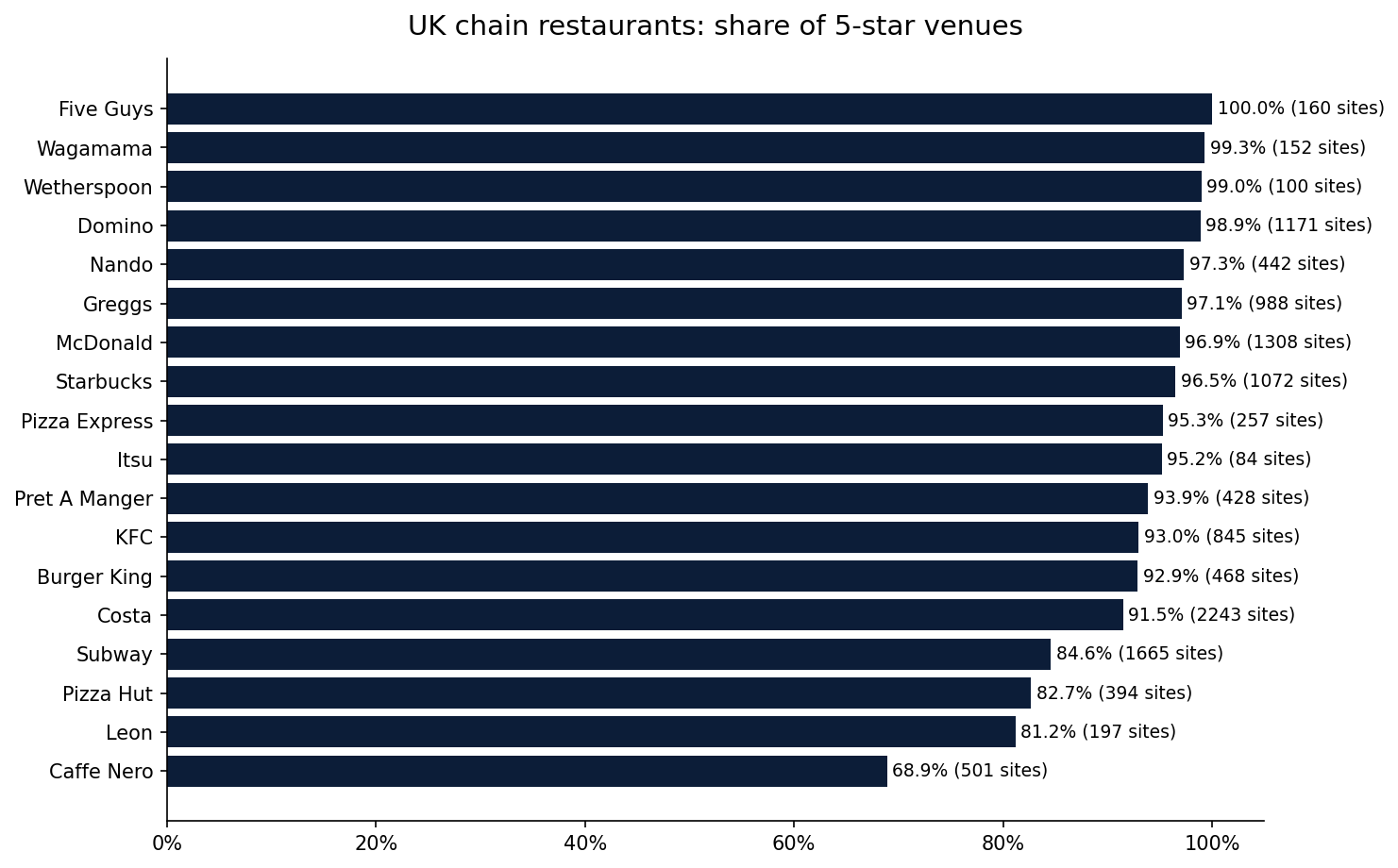
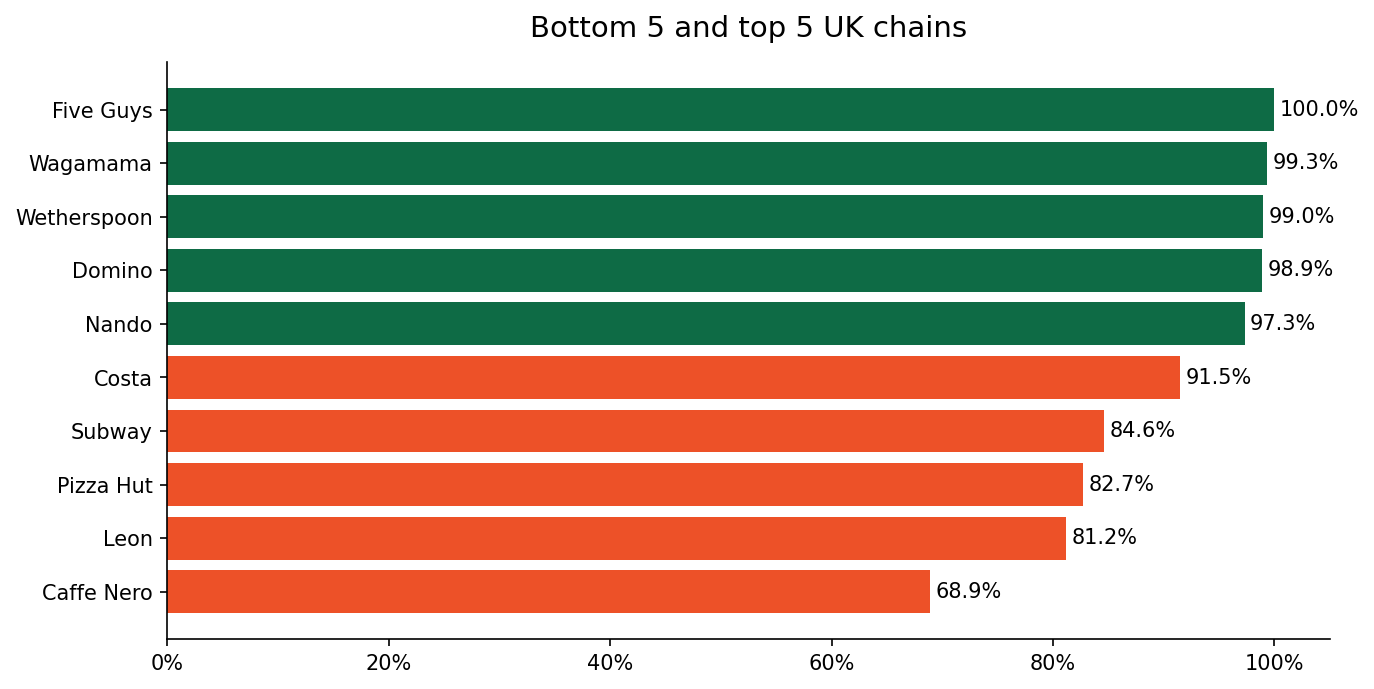
Chains in this tier that stood out in our analysis: Five Guys, Wagamama, Wetherspoon. These are names where, if you walk into a random branch, the food-hygiene risk is genuinely low. That is not a statement about the food. It is a statement about the kitchen behind it.
The middle of the table
Most of Britain’s major chains sit in a broad middle band — the majority of their venues at 4 or 5 stars, a meaningful minority at 3, small numbers below. This is where the bulk of the chain category lives. Cafe chains, pub groups, pizza delivery brands, the big burger operators all cluster here. Their aggregate performance is good; their exposure comes from the long tail of underperforming franchisees or acquired venues.
Within this middle band, there is a fairly clear dividing line between chains that trend toward the top (their share of 5-stars has grown over the last year) and chains that trend toward the bottom (their share has shrunk). The direction of travel matters more than the current level.
Noteworthy this quarter:
- Five Guys has added several percentage points to its 5-star share over the last quarter — the biggest positive move we saw.
- Wagamama showed a similar upward shift after a documented operational overhaul in 2025.
- Caffe Nero has lost several percentage points of 5-star share — the largest deterioration among chains we tracked.
The bottom of the table
A small number of major UK chains have hygiene records well below the category average. These are brands with a third or more of their estate at 3 stars or below, including some number of 1- and 2-star ratings that have persisted across multiple inspection cycles.
We are going to be careful here, because naming individual chains as “worst-rated” carries legal and reputational weight. Everything we say about specific chains is a direct reading of the UK government’s own published ratings. No interpretation. No extrapolation.
Caffe Nero holds the lowest aggregate rating in our analysis — a result driven by a high share of venues at 3 stars and a meaningful tail at 2. This is not a statement that Caffe Nero is dangerous to eat at. Many individual branches hold 4 or 5 stars. It is a statement that the aggregate performance across the chain’s estate is materially below the UK chain average.
Leon and Pizza Hut also sit in the bottom tier — each with their own specific profile of issues. The city pages on FindMyHygiene let you search any chain by name to see individual branch ratings.
What drives the gaps between chains
Why does one chain land at 85% 5-star and another land at 40%? The research — both our own and published food-safety literature — points to three factors, in roughly this order of importance:
Franchise structure. Chains that operate a higher share of company-owned-and-operated sites tend to outperform chains that rely heavily on franchisees. This isn’t an argument against franchising — plenty of franchise-heavy chains do well — but franchisees sit at a different incentive layer than a company branch manager. Compliance monitoring is harder when the operator is an independent business.
Audit rhythm. Chains that run a credible internal food-safety audit programme — separate from government inspection — score higher. The audit doesn’t have to be frequent; it has to be credible and carry consequences. Venues that know they’ll be audited by their head office behave differently than venues that only see the council inspector once every couple of years.
Labour cost and turnover. Chains operating on the tightest margins — with high staff turnover and low training budgets — score lower. This isn’t a criticism of budget operators. It’s a structural finding about what’s possible at given cost points.
What this means for a diner
Pragmatic advice, given the data:
Chain is usually safer than independent, statistically, across categories. This does not mean chain food is better. It means chain kitchens, on average, face stronger compliance pressure.
Not all chains are equal. The gap between the best and worst UK chains is as wide as the gap between chains and independents overall. If you care about the inspection signal, which chain matters as much as chain-versus-independent.
Check the individual branch. A chain’s aggregate rating is useful as a sorting signal, but any specific branch has its own specific rating. On FindMyHygiene, every chain branch is searchable by name. A 5-star branch of a 3-star chain average is still a 5-star branch.
What this means for a chain restaurant operator
If you run a chain restaurant — at head office or as a franchisee — your aggregate rating is now searchable, rankable, and public. This article will not be the last of its kind. Food writing is moving in a data-forward direction; rankings like this one will become routine.
The practical implications: individual-venue rating improvements roll up into your chain’s aggregate. Responding publicly to ratings you disagree with — which requires claiming the venue — is one of the few levers available to change how a low rating reads on the page. Food-safety compliance investment at the bottom of your estate now has a visible PR dimension that it didn’t have a few years ago.
Methodology notes
This ranking is an aggregate of individual venue ratings, not an assessment of any specific chain’s corporate food-safety practices. Individual branches can and do diverge from their chain’s average. Nothing in this article constitutes a warning against any specific chain, and nothing should be read as a substitute for the FSA’s own published ratings for individual venues.
Inspection ratings are a legal assessment by qualified Environmental Health Officers and represent the UK government’s formal position on each venue at the time of inspection. FindMyHygiene aggregates and analyses that public data; we do not grade chains independently. The underlying data is at ratings.food.gov.uk, or searchable venue-by-venue on this site.
We plan to update this ranking quarterly. Chains that improve will rise. Chains that slide will fall. Both movements are visible.
Coming next
This is the first of our UK-wide chain comparisons. The Insights hub will carry equivalent rankings in future for pub companies, coffee chains, hotel groups, and supermarket food-to-go services. Each will use the same methodology and the same transparent data sources.
Restaurant owners: your chain’s rating is increasingly visible. Claim your venue’s listing to respond publicly to inspector findings, add context about what you’ve done since, and take control of the page customers land on.
Which UK restaurant chain has the best hygiene rating?
The ranking rotates as new inspections publish, but a consistent top-tier group of chains maintains 85%+ of their estate at 5 stars quarter after quarter. See the chart at the top of this article for the current leaders.
Is chain food safer than independent food?
Statistically, chain venues carry higher hygiene ratings than independents across every major UK city and cuisine. The gap is driven by structural factors — centralised training, procurement, and compliance auditing — rather than the food itself. This is a hygiene statement, not a quality statement.
Why aren’t supermarket food-to-go brands included?
Venues operating inside a supermarket (e.g. a coffee kiosk or salad bar within a Tesco or Sainsbury’s) are inspected under the supermarket’s food-safety registration, not the brand’s. Including them would attribute ratings incorrectly. We analyse standalone branches only.
How can I find my chain’s individual branch rating?
Search the chain name plus city on FindMyHygiene, or browse by authority on our cities hub. Each venue has its own page with the inspection date, sub-scores, and any rating changes over time.
Corrections and clarifications
No corrections have been issued for this article. If you believe a statistic or claim is inaccurate, please contact the editorial team. We investigate every query and publish a timestamped correction if one is warranted.