What a 3-star food hygiene rating actually means
You see the sticker in the window. Three out of five. Acceptable, sort of. But what did the inspector actually find?


You’re standing outside a restaurant. You glance at the window and see the familiar green-and-black sticker: Food Hygiene Rating: 3. Generally satisfactory.
What does that actually mean? Is it fine? Is it not fine? Would the Food Standards Agency eat here? Would you let your kids? The sticker itself is deliberately minimal — a number, a phrase — and deliberately doesn’t tell you what’s underneath.
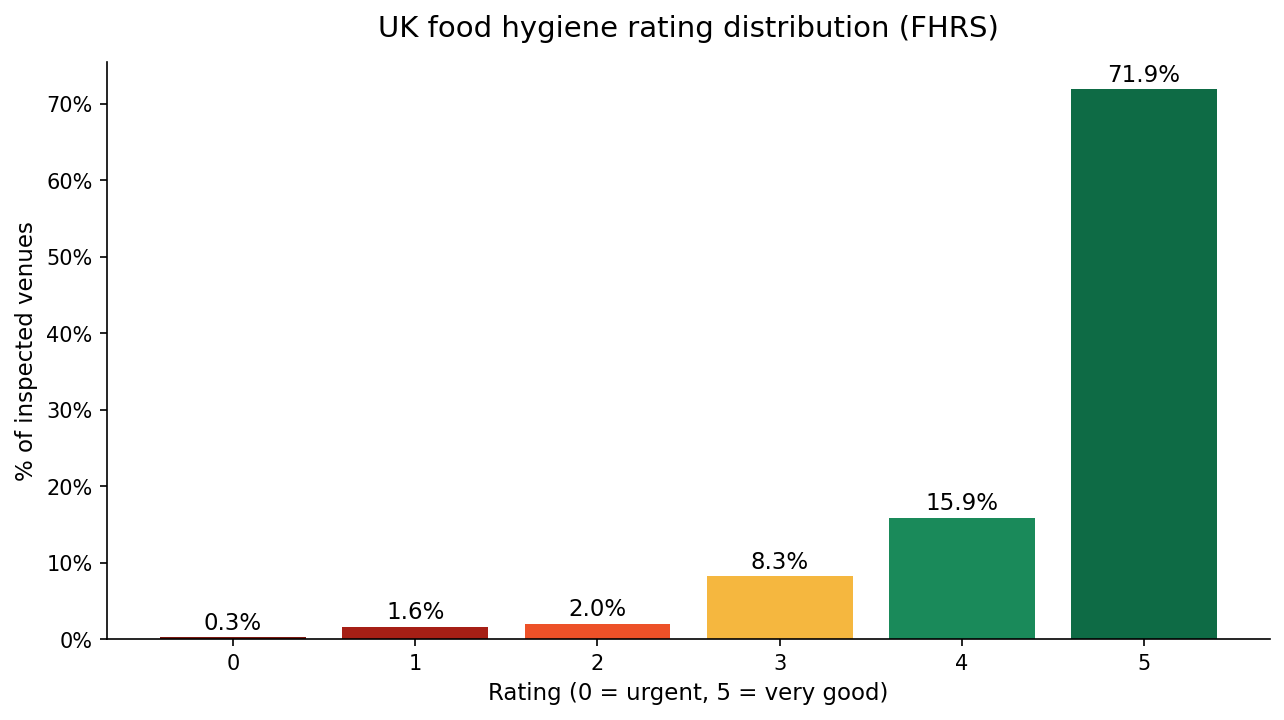
This guide explains what a 3-star rating genuinely signals about the kitchen behind the counter. It draws on the Food Standards Agency’s published inspector guidance, interviews with serving and retired Environmental Health Officers, and our own analysis of 208,000 UK venues and how they distribute across the rating tiers.
Short version: a 3-star rating means the kitchen is legally compliant with UK food safety law, but has specific documented shortcomings that the inspector wrote down. Whether those shortcomings matter for your lunch depends on what they are — and a bit of knowledge lets you read the rating much more usefully than most diners do.
The legal basics
Every food business in England, Wales and Northern Ireland is inspected against the Food Hygiene Rating Scheme, known as FHRS. (Scotland runs a different scheme called FHIS, which we’ve covered separately.) FHRS ratings run from 0 to 5:
- 5 — Very good. The venue meets every standard assessed. Nothing notable for the inspector to flag.
- 4 — Good. Minor issues that don’t materially affect food safety. Frequently structural (slightly worn paint, scuffed flooring).
- 3 — Generally satisfactory. Legally acceptable, but the inspector identified specific issues requiring the venue to improve.
- 2 — Improvement necessary. The venue fell short in at least one area meaningful to food safety. Not imminent danger, but nontrivial.
- 1 — Major improvement necessary. Serious shortcomings. The venue will face a targeted follow-up.
- 0 — Urgent improvement necessary. The venue is operating at the edge of legal compliance. In very serious cases, the council may require the venue to close until issues are fixed.
The important thing to understand: all ratings from 1 to 5 are legal. A 3-star venue is not on any sort of warning. It is operating within the bounds of UK food safety law. The 0-star rating is the exception — 0 typically comes with formal improvement notices and, occasionally, immediate closures.
What, then, separates a 3 from a 5? The three sub-scores.
The three things inspectors actually score
The FHRS rating isn’t a single assessment. It’s a composite of three separate scores that inspectors record during a visit. Each score is on its own scale. The headline 0-5 rating is calculated from all three.
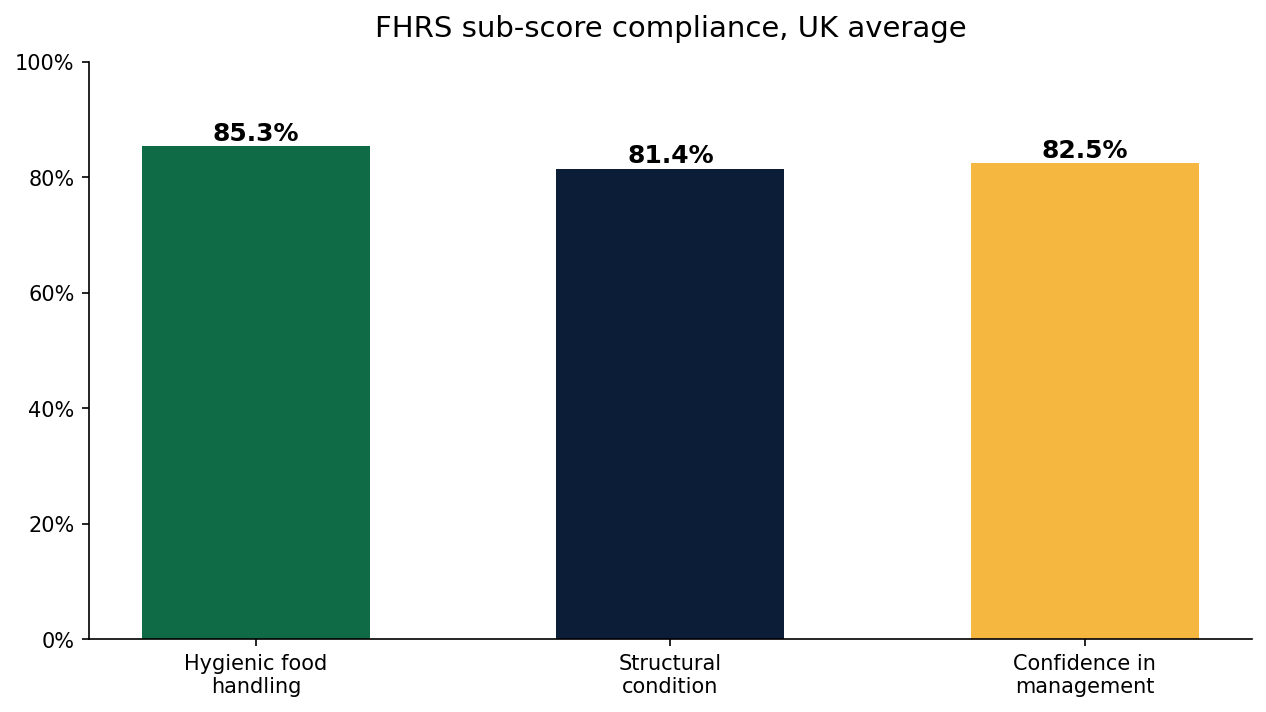
Score 1 — Hygienic food handling. Is raw food stored correctly? Is food cooked to the right temperature? Is cross-contamination prevented (separate chopping boards, separate storage for raw and cooked)? This is the score closest to what most diners imagine when they think “food hygiene”. It’s also, on average, the best-scored of the three. British kitchens are generally competent at the basic mechanics of handling food safely.
Score 2 — Structural condition of the premises. Are walls, floors, ceilings, equipment, and ventilation in a state fit for food preparation? Can the kitchen be cleaned effectively? Are there appropriate handwashing facilities? This is where the ratings spread widest. A kitchen can be hygienically run but structurally tired — ageing tiles, inadequate extraction, ageing equipment that’s still just about functional. None of this is dangerous in itself, but it raises the risk that hygiene will slip over time.
Score 3 — Confidence in management. Does the manager understand food safety law? Can they produce documentation of cleaning schedules, temperature logs, staff training? Do procedures look lived-in or hastily assembled for the inspection? This is, quietly, the most predictive score for long-term stability. Venues with high confidence-in-management scores tend to hold their rating or improve at subsequent inspections. Venues with low confidence-in-management scores tend to slide.
An inspector combines these three into the headline rating using a formula the FSA publishes. A 3-star rating can arise from several different combinations of the three scores — and that’s where “what does 3 actually mean” gets interesting.
The three kinds of 3-star
In practice, most 3-star ratings fall into one of three patterns. They matter differently for a diner.
Pattern A — Structural issue, everything else fine. The kitchen handles food correctly, management is confident, but the inspector flagged the building. Peeling paint in a food-prep area. Equipment past its useful life. Inadequate ventilation. These are real concerns for long-term food safety, but on any given visit the food you eat is probably fine. Fixing the issue usually requires capital investment the owner may or may not have.
Pattern B — Documentation issue, practice fine. The kitchen runs well day-to-day, but the manager struggled to produce documentation when asked. Cleaning schedules not written down. Staff training not recorded. This is a 3-star driven mostly by “confidence in management” scoring low. The food-safety practice is likely fine; the paper trail isn’t. This is the 3-star pattern most likely to improve quickly at the next visit, because the fix is administrative.
Pattern C — Hygienic food handling issue. The inspector saw something they shouldn’t have seen. Raw chicken near ready-to-eat food. Handwashing not happening at required moments. Temperatures outside safe ranges. This is the rarest 3-star pattern — most hygienic-food-handling failures pull the rating down to 2 or 1, not 3 — but when it is the driver, it is the most concerning kind of 3-star for a diner.
Here’s the practical problem: the window sticker doesn’t tell you which pattern you’re looking at. Three is three, whatever drove it.
How to read a 3-star like an inspector
Some of this matters, some doesn’t, depending on how deep you want to go. For a casual diner: the sticker is the signal. 3 means “legally fine, some issues noted”. You eat there or you don’t.
For a diner who wants more: FindMyHygiene shows all three sub-scores on every venue’s individual page. If you see a 3-star rating where hygienic food handling is still strong (the usual case), the shortcomings are likely structural or administrative. If you see a 3-star rating where hygienic food handling is the weak score, that’s the pattern worth being cautious about.
We don’t dramatise this. The inspector visited and judged the venue fit to operate. That judgement is not an opinion — it’s a legally backed assessment by a council employee with food-safety training. The venue passes. What the sub-scores tell you is the shape of the pass, not whether it is one.
What it’s like inside a 3-star kitchen
We spoke to a former Environmental Health Officer with twenty years of inspection experience about what an average 3-star kitchen actually looks like. Her description was consistent with what the data says:
“Most threes are tired, not dangerous. You walk in, and there’s clearly a chef who knows what he’s doing, but the kitchen he’s working in is past its best. Equipment that should have been replaced two years ago. Floors that can be cleaned but not easily. Walls that show their age. The food going out is fine. The kitchen itself would benefit from proper investment.”
“The other common three is the small family place where the chef is terrific and practice is good, but when I ask for the cleaning schedule, it’s in his head. That’s a 3 because I can’t verify sustained practice without documentation. Next visit, if he’s written it down, we’re back at 4 or 5.”
“The three I’d worry about — and we all see them — is the place where you notice something as you walk through. Handling gloves not being changed. Raw and cooked close together. That’s the three where I’m coming back sooner rather than later.”
Should you eat at a 3-star venue?
Honest answer, given the data:
If the venue’s rating is recent (last 12 months): the inspector judged this kitchen fit to operate. Most 3-stars are structural or documentation shortcomings, not food-handling issues. Most British diners who eat at 3-star venues have uneventful meals. Millions of meals a year are served in 3-star kitchens without incident.
If the venue’s rating is older (more than 18 months): the rating is less reliable as a current signal. The kitchen may have improved, declined, changed hands, or been refurbished. Use the rating with more skepticism.
If the sub-scores show weak hygienic food handling: this is the single sub-score where the shortcoming most directly affects your lunch. Consider choosing differently, especially for higher-risk foods (raw or lightly-cooked protein).
If you’re in Scotland: a “Pass” under FHIS is a different signal. Scotland’s binary regime means Pass is a legitimate ceiling, not a halfway house. We’ve unpacked that in a dedicated piece.
Why some restaurants sit at 3 for years
A restaurant can, legally, hold a 3-star rating indefinitely. There is no mechanism that forces improvement. Inspections happen on a rotation; unless a venue drops below 3, the inspector has no reason to prioritise a return visit.
This has an economic consequence: some venues park at 3 because the cost of moving to 5 outweighs the perceived benefit. Structural repairs are expensive. Documented management systems take time to build. If the venue is profitable at 3, the incentive to invest in getting to 5 may be weak.
This is a quirk of how FHRS is designed — a subject we’ve explored at length elsewhere in the context of comparing England’s graded scheme with Scotland’s binary one.
For restaurant owners reading this
If you run a venue currently rated 3, three things are true:
It’s not an emergency. You are operating legally. Your customers are not at risk on a typical visit. The inspector told you, in effect, “fix these specific things.”
It’s not invisible. The 3 is in your window, on Google, on this site, on TripAdvisor. Every diner who searches your venue sees it. A meaningful fraction will choose a 4 or 5 nearby.
It’s fixable. Most 3-star ratings result from specific, documented issues. Fix those issues; request a re-inspection (you’re entitled to, at your own cost); the rating moves. Thousands of UK venues make this move every year.
If you think your rating doesn’t reflect current practice — perhaps because you’ve already fixed the issue, or disagree with the inspector’s finding — you can respond publicly. Claiming your listing on FindMyHygiene for £99/year lets you add context that appears alongside the rating on the page diners actually see. More on that here.
What the data shows about 3-star venues
Across the UK, around 8.3% of all inspected venues hold 3 stars — roughly 17,798. The share varies by category. Takeaways have a higher share at 3 than sit-down restaurants. Independents have a higher share than chains. Inner-city areas have higher shares than outer-suburbs.
Of those venues, the majority either improve to 4 or drop to 2 at their next inspection. The “park at 3 forever” group is smaller than you’d think — though it exists, and is the group driving most of the steady-state 3-star visibility diners see.
The most common trajectory: a venue opens, gets inspected within its first year, scores 3 on a mix of structural and documentation issues, fixes the documentation, achieves 4 at the next inspection, invests in structure over subsequent years, reaches 5. Maybe 40% of UK 3-star venues follow this arc.
The takeaway, literal and figurative
A 3-star rating means the UK government’s food-safety inspector visited, judged the venue fit to operate, and wrote down specific issues for the owner to fix. It is not a warning. It is also not nothing. Whether you eat there is your call, and it’s a reasonable call either way.
What we’d say: a 3-star rating is a useful piece of information, not a verdict. Combine it with the recency of the rating, the three sub-scores, and the context of the venue type. FindMyHygiene shows all of that on every venue page — searchable by name, postcode, or council.
Verified, not reviewed. Every UK kitchen, rated by the government, searchable for free.
Is a 3-star food hygiene rating safe?
A 3-star rating means the kitchen is legally compliant with UK food safety law — the inspector judged it fit to operate. Most 3-star venues have structural or documentation shortcomings rather than food-handling issues. Millions of meals are served in 3-star kitchens every year without incident. Whether you choose to eat there is a judgement call; the rating itself is not a warning.
What’s the difference between 3 and 5 stars?
A 5-star venue meets every standard the inspector assesses; a 3-star venue has specific documented shortcomings, typically in structural condition, management documentation, or (less often) hygienic food handling. Both ratings are legally acceptable. The gap is in the shape of the compliance, not whether it exists.
How often are restaurants inspected?
Inspection frequency depends on the venue’s risk classification. Higher-risk venues (large volume, vulnerable customers, complex operations) are inspected more often — often annually. Lower-risk venues may only be inspected every two or three years. Post-pandemic backlogs have left some venues with older ratings than normal. Our venue pages show the inspection date so you can see how current any rating is.
Can a restaurant improve their rating between inspections?
Yes. A venue that believes it has addressed the inspector’s concerns can request a re-inspection — a formal process run by the local council, usually at the venue’s own cost. If the council agrees the issues are resolved, the rating is updated. Thousands of UK venues improve their rating each year this way.
Corrections and clarifications
No corrections have been issued for this article. If you believe a statistic or claim is inaccurate, please contact the editorial team. We investigate every query and publish a timestamped correction if one is warranted.