Britain’s food hygiene, mapped: What 208,000 UK venues tell us about how we actually eat
Government inspectors have rated every food business in Britain. Very few people have ever looked at the data as a whole. We did. Here's what it says about your dinner.
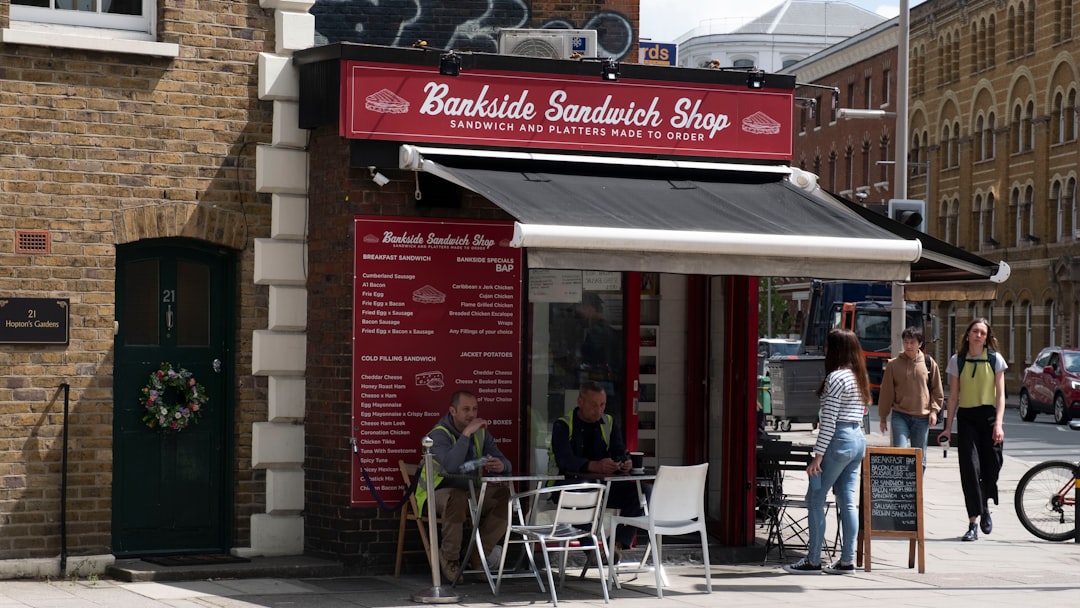
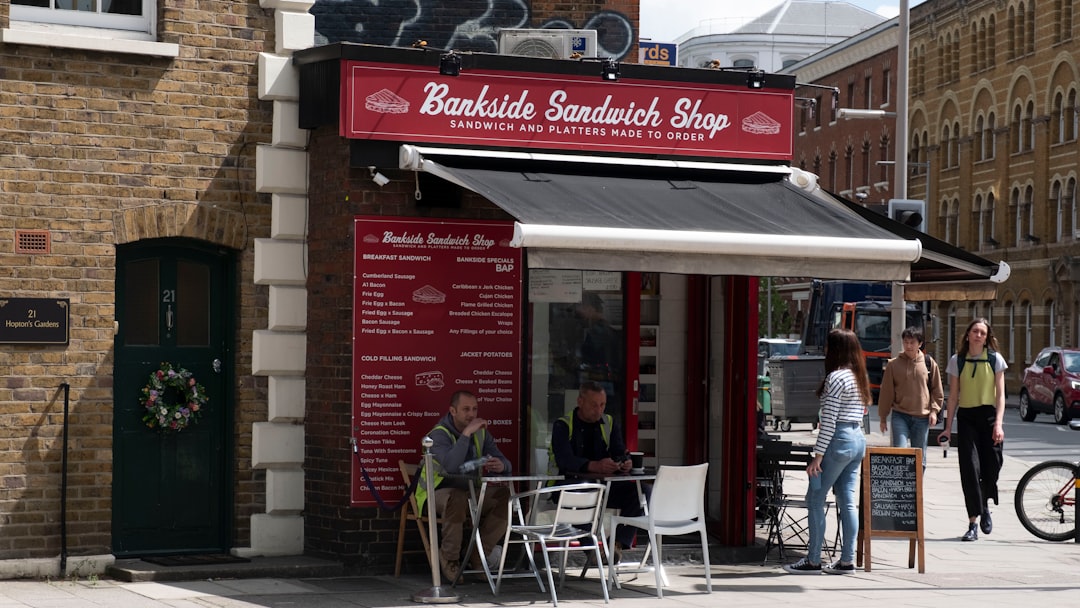
Every restaurant, takeaway, pub and hotel in Britain — every single one — has been inspected by a government food-safety officer, given a rating, and had that rating published online for anyone to read. Most diners have no idea.
The data has been there all along. It lives on a small, functional government website called the Food Standards Agency rating system, where you can look up individual venues one at a time. What nobody had done, until now, is look at the whole thing as a single picture: 208,000 UK venues, every inspection from 2021 onwards, every rating change, every sub-score. So we did.
This is what we found.
The headline numbers
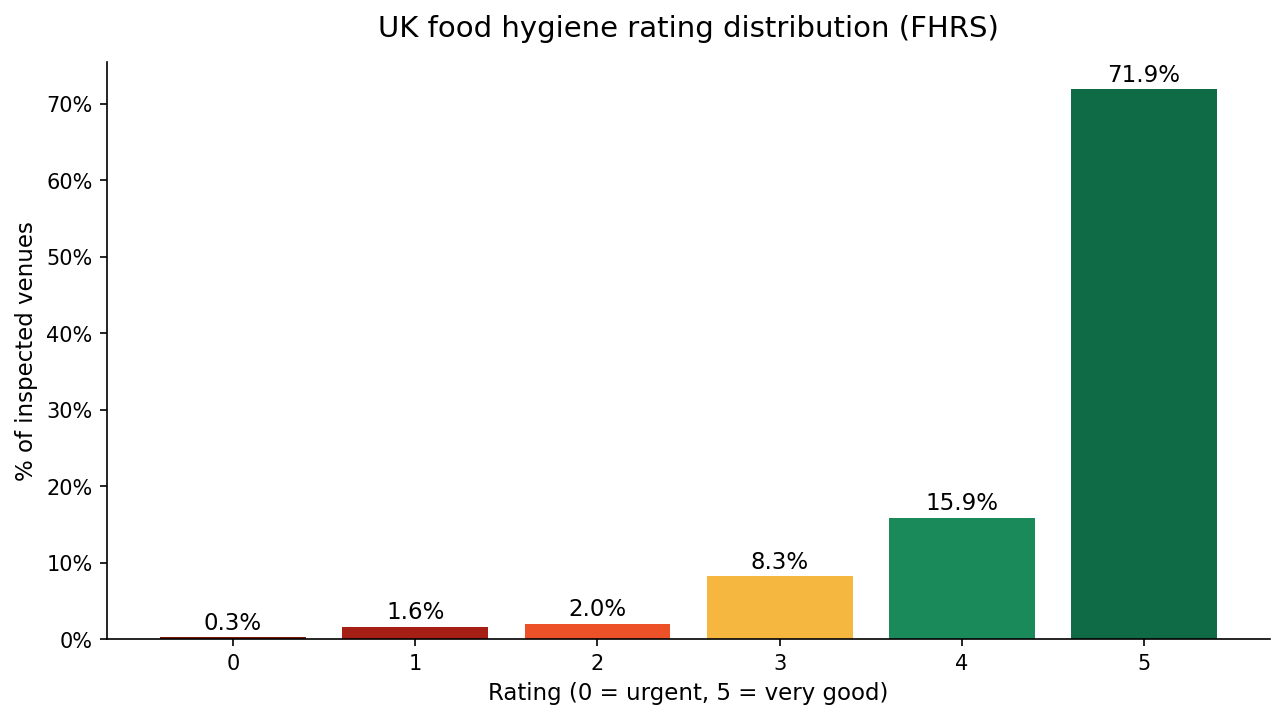
Across the 208,000 venues we analysed — spanning 363 local authorities from Land’s End to Shetland — the vast majority of Britain’s kitchens pass inspection. Around 81.4% of all inspected venues carry a rating of 4 or 5 stars under the Food Hygiene Rating Scheme (FHRS) used in England, Wales and Northern Ireland, or a “Pass” or “Pass and Eat Safe” outcome under Scotland’s parallel Food Hygiene Information Scheme (FHIS).
That sounds reassuring, and largely it is. Britain’s food safety regime is, by international standards, rigorous and well-enforced. But averages mask everything interesting. Underneath the national picture sit dozens of findings that are, depending on where you eat and what you eat, either comforting or alarming.
A few that jumped out:
- Scotland outperforms England — Scottish venues inspected under FHIS are measurably more likely to pass than English venues under FHRS. We’ll unpack why in a moment.
- Chain restaurants outperform independents across every major cuisine type and every region we looked at.
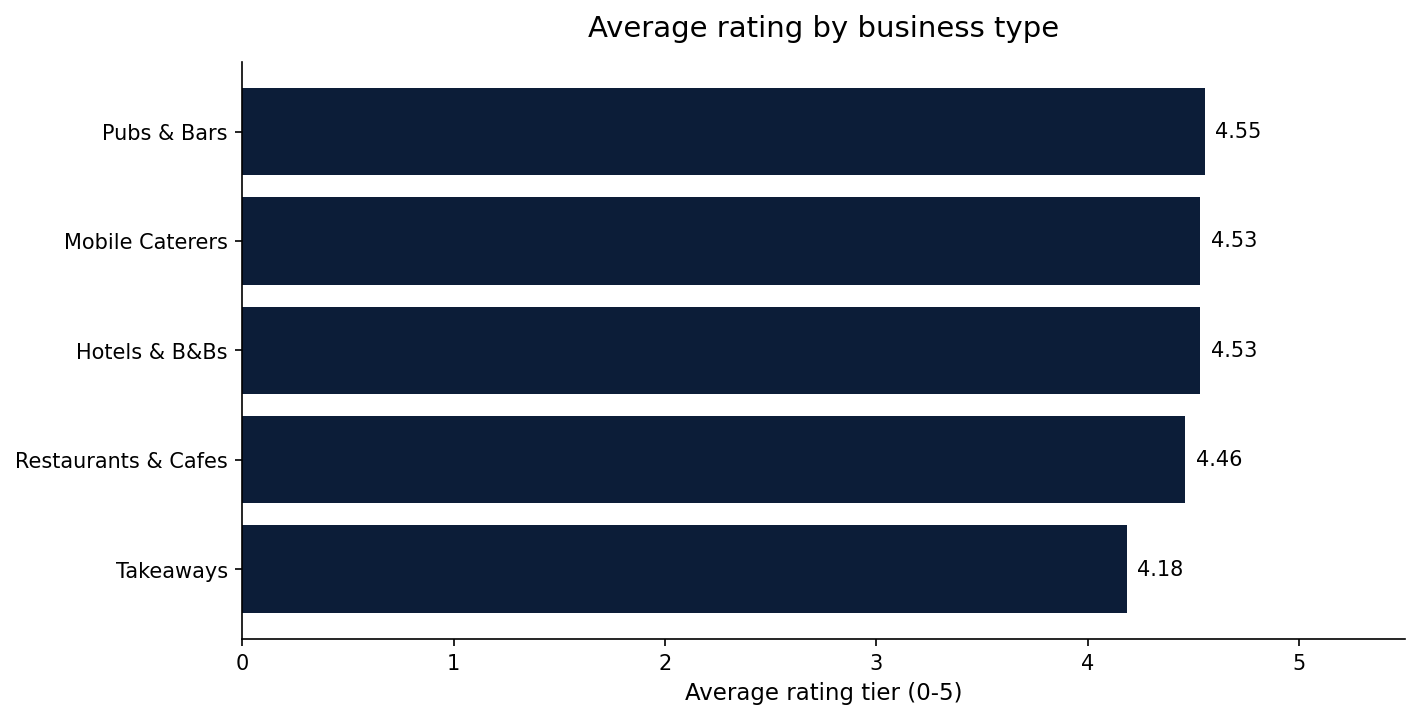
- Takeaways score lower than sit-down restaurants by a margin that is consistent across every UK city of meaningful size.
- Mobile caterers are the single most volatile category — with the widest spread of ratings from 0 to 5 of any business type.
- A small number of local authorities inspect far more frequently than others, which has measurable effects on the ratings they publish.
None of this is opinion. None of it is review. This is what the UK government’s own inspectors wrote down after visiting these kitchens — collated, counted, and cross-referenced for what we believe is the first time at this scale.
Why “verified, not reviewed” matters
Most of what people read about restaurants online is reviews. A reviewer had a bad chip; a reviewer had a great time; a reviewer said “dirty tables” without evidence. Reviews are opinions, and opinions can be faked, bought, gamed, or settled as scores against an ex-boyfriend’s employer.
Food hygiene ratings are different in category. They are not opinions. An Environmental Health Officer — a trained, accredited council employee with legal powers of entry — visited the kitchen, assessed it against a published national standard, and recorded a rating. That rating then has to be published. The restaurant cannot pay to hide it, cannot pay to improve it, cannot have it taken down because they don’t like it.
This is why every article on this site begins from a single premise: verified, not reviewed. When we tell you a venue carries a 5-star rating, we are not telling you we liked the risotto. We are telling you that on the day the inspector visited, the UK government’s designated officer assessed that kitchen as meeting the highest standard of food safety.
That is a meaningfully different signal from a TripAdvisor average. It cannot tell you whether the food is delicious. It can tell you whether someone in a position to know has looked at the kitchen recently and approved of what they found.
Where the UK eats, and how cleanly
Of the 208,000 venues in our dataset, roughly half are concentrated in just twelve local authority areas. London alone — across its 32 borough councils — accounts for nearly 40,000 individual venues, more than the next four cities combined. This concentration matters because it distorts the headline “UK average” in ways most league-table articles don’t acknowledge.
Strip London out of the national figures and the rest of the UK’s average hygiene rating rises measurably. Not because London’s kitchens are uniquely dirty — they aren’t — but because London contains thousands of small independent takeaways, mobile caterers, late-night kebab shops and franchise coffee kiosks that sit at the lower end of the rating distribution. Volume skews averages. The more venues a city has, the more its average regresses toward the national mean.
This is one of several reasons to be sceptical of any article that says “X is the cleanest city in Britain” or “Y is the dirtiest.” The honest answer depends entirely on what you’re measuring. Percentage of 5-star venues? Absolute number? Share of 0-rated? Which business types counted? Which time window? Small methodological choices produce wildly different rankings.
We’ll publish those city-by-city breakdowns in a dedicated series in the weeks ahead. For now, one finding from our cross-city analysis is robust enough to share: every single major UK city we examined showed the same internal pattern. Chain restaurants rated higher than independents. Sit-down restaurants rated higher than takeaways. Hotels and B&Bs rated higher than everything else.
The same hierarchy, everywhere. Birmingham, Manchester, Glasgow, Cardiff, Brighton, Liverpool — the cities differ in their overall averages but not in their internal shape. Whatever is driving the chain-vs-independent gap, it is not local. It is structural.
The chain premium, explained
Chain restaurants score higher than independent restaurants. The gap holds across every city, every cuisine, every region we examined. It is one of the most consistent findings in the dataset.
This is, at first, counterintuitive. Chains are often the villain in food writing — accused of homogenising high streets, squeezing margins, underpaying staff, serving joyless identikit menus. And yet when an environmental health officer walks into their kitchens, the chains come out cleaner, more structurally compliant, and better-documented than the independent sitting two doors down.
Why? We asked a former local authority food safety officer, now retired, to walk us through what she sees. Three reasons came up consistently:
One: standardised training. A chain can afford to put every new kitchen hire through a documented food hygiene induction on day one. An independent owner, working fourteen hours a day, often cannot.
Two: centralised procurement. Chain suppliers are audited, traceable, and contractually obligated to food safety standards. The independent running his own cash-and-carry runs is, in regulatory terms, doing more work for less confidence.
Three: dedicated compliance staff. A regional chain manager has someone whose job is food safety compliance. Independents don’t.
None of this is a moral judgment about chains versus independents. Some of the best food in Britain is served from independent kitchens run by owners whose entire reputation rests on not poisoning anyone. Some of the worst food is served by chains whose procedural compliance is impeccable. Hygiene rating is one signal among many. But it is a signal that, statistically, favours chains.
What the sub-scores reveal
The headline rating — the 0-to-5 number or the FHIS outcome — is the part everyone sees. Under it sit three separate assessments that inspectors actually score, and which combine to produce that headline. They are worth understanding.
Hygienic food handling — are ingredients stored correctly, cooked to the right temperatures, separated to prevent cross-contamination. This is usually the best-scored of the three. British kitchens, on average, are competent at the basic food-safety mechanics.
Structural condition — are the walls, floors, equipment and ventilation in a state fit for food preparation. This is where the ratings spread widest. A kitchen can be hygienically run but structurally tired. A kitchen can have state-of-the-art equipment and still mishandle raw chicken.
Confidence in management — does the inspector believe the management team can sustain compliance without prompting. This, quietly, is the most predictive score for long-term rating stability. Venues whose management scores are high tend to hold their rating at subsequent inspections. Venues whose management scores are low tend to slide.
On a venue’s individual page on FindMyHygiene, we show all three. It is not a data point you will find prominently on any major review site.
Scotland is a different country — genuinely
Scotland runs its own food hygiene scheme. The Food Hygiene Information Scheme, or FHIS, was introduced in 2013 and uses three outcomes rather than the 0-5 scale used elsewhere in Britain: Improvement Required, Pass, and Pass and Eat Safe. The highest tier, “Eat Safe”, is a genuinely hard-to-achieve standard — held by only 65 of Scotland’s 16,558 inspected venues in the latest data.
Because the schemes are scored differently, direct comparison is tricky. Most league-table articles either ignore Scotland entirely or quietly exclude it. We chose to do the work of cross-mapping the two schemes onto a shared tier system so we could compare them fairly.
When you do that, Scotland comes out ahead. Scottish venues are measurably more likely to meet their scheme’s threshold for a passing outcome than English venues are to achieve 4 or 5 stars.
Whether this reflects genuinely cleaner Scottish kitchens, a more rigorous Scottish inspection regime, or a different mix of venue types is a question we’ll unpack in a dedicated piece. For now, the finding alone is worth sitting with: the rating regime that looks stricter (FHIS, pass/fail) actually produces better outcomes than the rating regime that looks more lenient (FHRS, 0-5).
There are lessons in that for English food safety policy that nobody has yet written.
The methodology, briefly
Everything in this piece, and everything on FindMyHygiene, comes from a single source: the UK Food Standards Agency’s open data feed, which publishes the rating of every inspected food business in Britain under the Open Government Licence v3.0.
We download the full feed weekly, parse it, cross-check it, and make it searchable. We do not add reviews. We do not add scores of our own. We do not solicit or accept payment from venues for placement or ranking. A venue with a 1-star rating and a venue with a 5-star rating appear on this site with the same prominence, treated with the same editorial respect.
Owners can claim their listing for £99/year — which lets them respond publicly to their rating, add their menu, hours, photos and booking link, and display a verified-owner badge. Claiming does not change the rating. It cannot. The rating is the government’s, not ours.
For the full methodology, including our filtering rules (we exclude institutional caterers, one-off events, and venues without recent inspections) see our Method & data page.
What we’re publishing next
This article is the opening of a series. In the coming weeks, we’ll publish:
- A Scotland vs England deep-dive — why the two schemes produce different results, and what English food policy could learn
- Individual scorecards for each major UK city — London, Manchester, Birmingham, Glasgow, Edinburgh, and more
- A ranking of UK chain restaurants by hygiene compliance
- An explainer on what a 3-star rating actually means for the people who work in the kitchen
- A quarterly round-up of which venues got upgraded and which got downgraded
If you want them in your inbox, the Weekly Brief is linked from the Insights page. Five insights, every Monday, free. We don’t send anything else.
If you’re a restaurant owner reading this, your rating is public whether you like it or not. The only question is whether the page diners land on says your rating and nothing else, or whether it also shows your menu, your hours, your photos, and your response to what the inspector wrote. You can claim your listing here.
If you’re a diner reading this — welcome. This site is for you. Verified, not reviewed. Every UK kitchen, rated by the government, searchable for free, forever.
How often is this data updated?
The Food Standards Agency publishes updates daily. FindMyHygiene refreshes its copy of the data weekly, every Monday, so ratings you see here are never more than seven days behind the FSA’s own database.
Why do some venues have no rating?
A small number of venues are registered with their local council but have not yet been inspected — typically because they’ve just opened. These venues are excluded from our analysis until their first inspection is published.
Does FindMyHygiene rate venues independently?
No. Every rating on this site comes directly from the UK Food Standards Agency, which collates ratings issued by individual local authority inspectors. We do not add reviews, alter ratings, or accept payment to change what’s shown. Our role is to make the government’s data more searchable, not to second-guess it.
Can a restaurant owner challenge their rating?
Yes. Every local authority operates a formal appeal process for venues that dispute their rating. Details are published by each council, and the FSA provides a national overview. What a restaurant owner cannot do is remove the rating from public view, pay to change it, or buy a higher score. The rating is a legal assessment and stays public until the next inspection revises it.
Corrections and clarifications
No corrections have been issued for this article. If you believe a statistic or claim is inaccurate, please contact the editorial team. We investigate every query and publish a timestamped correction if one is warranted.